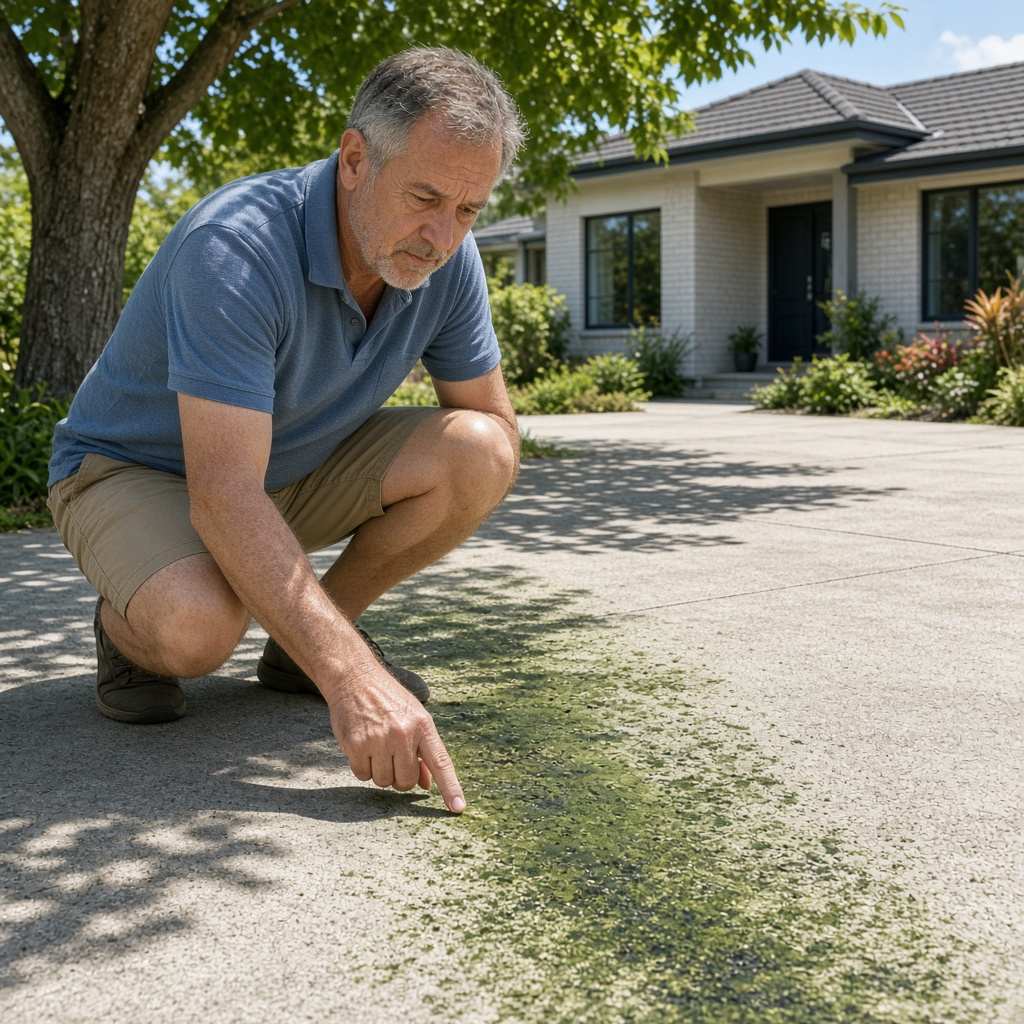
Driveways turn green in Northern Virginia because algae grows in the region’s humidity and thrives on shaded, damp concrete. The green film is a living organism, not loose dirt, which is why a garden hose does not remove it and why it comes back if only rinsed. In Gainesville and the surrounding area, the combination of frequent rain, tree cover, and freeze-thaw winters makes green and gray driveways a yearly problem.
It Is Algae, Not Dirt
The green on a driveway is algae, a plant-like organism that takes root in the pores of concrete. Concrete is porous and holds moisture, which gives algae exactly what it needs. Because the algae is alive and rooted in the surface, rinsing with water lightens it but leaves the roots behind to regrow. Removing it for good takes a cleaning solution that kills the organism, followed by a surface cleaner that lifts it out of the pores.
Why Northern Virginia Driveways Are Prone to It
The climate is the root cause. The 1991–2020 normals at Washington Dulles show 43.24 inches of annual rain and a 55.7-degree mean temperature — wet and warm enough to grow algae on any shaded concrete. Three local conditions make it worse in Gainesville:
- Shade and tree cover. Driveways under trees or on the north side of a home stay damp and grow green fastest. Gainesville’s wooded lots are prime for it.
- Humidity. Northern Virginia summers keep surfaces moist long after rain, feeding growth.
- Freeze-thaw winters. Dulles averages 21 inches of snow a season, and each freeze-thaw cycle works dirt and de-icing residue deeper into the concrete, adding gray staining on top of the green.
Green vs Gray: Two Different Stains
A Gainesville driveway often shows two problems at once. The green is algae, driven by moisture and shade. The gray-black staining is ground-in dirt and de-icing residue pressed into the pores by winter freeze-thaw cycles. Both come off with the same approach — a cleaning solution plus a flat surface cleaner — but they have different causes. Knowing the difference helps explain why a driveway that was rinsed last year is green again this year: the rinse never killed the algae.
How Concrete Cleaning Fixes It
Proper concrete cleaning removes both the algae and the embedded grime. A cleaning solution is applied to kill the algae at the root, then a flat surface cleaner passes over the concrete in overlapping rows for an even finish, lifting the dead growth and ground-in dirt out of the pores. A bare pressure wand leaves stripes; a surface cleaner leaves an even, restored surface. On paver driveways, common in Gainesville’s newer communities, the pressure is controlled to protect the joint sand.
A clean driveway stays clean longer when the algae is killed rather than just rinsed. If your Gainesville driveway has gone green or gray, call 123-456-7890 to reach a pressure washing provider, or read more about driveway and concrete cleaning.